
Work Packages

The basic concept of TRANSFoRm is that if data from research and clinical practice is to be integrated in support of patient safety, it is not sufficient to simply extract data from eHR systems, the data must be semantically enriched by the use of a live interface direct to the consultation. Similarly, automatic ‘translation’ of data is unreliable and a semantically aware workbench is needed to assist researchers in selecting appropriate codes. The core requirements for interoperability, semantically aware, dynamic interfaces and a rich ontology are common to all elements of research and knowledge translation, justifying their combination in this project and the ICT2009 work plan. TRANSFoRm will support clinical studies with potential patient safety value and directly support the use of evidence for diagnosis, reducing diagnostic error. Each WP will address one of the principal scientific objectives.
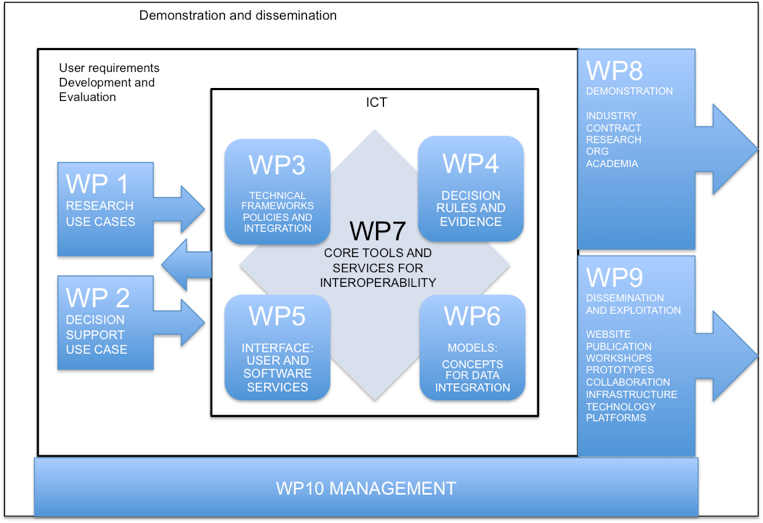
Transform - work packages diagram

Clinical Use Cases: Three clinical use cases will run throughout the project, supporting the ICT work packages in three phases: use case development, testing and validation, and evaluation. The three clinical use cases are representative of the two phases of Translational Research [WP1] and Knowledge Translation [WP2].

User requirements Analysis: Two work packages develop the clinical use cases into highly detailed user requirements specifications in Legal, Privacy and Security [WP3], Decision Support rules [WP4].

Models and Standards: WP6 will take the detailed requirements and develop extensions to models and standards.

Development and evaluation: Two work packages will develop the software and services based on the requirements, models and standards. WP5 will develop dynamic, knowledge-driven interfaces for clinicians and researchers. WP7 will develop the integrated software and services for TRANSFoRm.

Validation, Demonstration and Dissemination:  The software and services will be validated in the well-defined use cases [WP1 and WP2], with quality control and assurance monitored via WP3. WP8 will demonstrate the project results outside the existing use cases and WP9 will promote dissemination at all stages of the project. WP10 will hold the project management infrastructure and activities.

Work Package Details

  • WP1: RESEARCH USE CASES

    Two studies will form the well-defined use cases that are required to shape and develop the ICT tools in three phases, detailed use case specification, testing and deployment of prototypes, and validation of final software products. The projects will not be taken to final clinical completion but to proof of concept and piloting such that additional funding can be obtained to run the complete projects.

  • WP3: LEGAL, ETHICAL, AND SECURITY FRAMEWORK

    This work package will develop and maintain a legal and regulatory framework for the project at European level, consulting with regulators, including the European Medicines Agency and national regulators over requirements for clinical trial management software and its validation. It will use the WP5 provenance methodology to ensure traceability of decisions and analytical results generated by the system. We will also develop and implement software Quality Assurance and develop and maintain an ethical and privacy policy in consultation with key stakeholders. Finally, all these issues will be used to inform a full security policy and its implementation in all the products of the project.

  • WP5: USER AND SOFTWARE SERVICES

    This work package will develop the full set of user interfaces and underlying search tools. These will include (a) a generic method for enabling a dynamic interface for data capture and presentation for clinicians during the consultation and (b) a query formulation and generation tool for researchers and a graphical middleware layer for the presentation of results. This work package will also specify and develop tools to assess data accessibility, data quality, and comparability. Finally, a generic method of preserving and examining the provenance of data within the project will be developed and implemented for application in WP3.

  • WP7: CORE TOOLS AND SERVICES FOR INTEROPERABILITY

    Building on the concepts and models from WP6, a framework of service-based and agent-based architectures will link data integration services with clinical data and a workbench for deploying the semantically aware query tools to researchers. A clinical trial data management system will be integrated, using and developing the ePCRN open-source software in a European context, informed by the clinical use cases and the regulatory requirements. An ISO 11179 data standards repository will also be developed and deployed.

  • WP9: DISSEMINATION AND EXPLOITATION

    This work package will describe how the tools and services being developed in TRANSFoRm will be deployed and exploited within the European Clinical Research Infrastructures Network (ECRIN). The ICT tools will be based within the ECRIN data centres. A series of dissemination activities will also be planned throughout the project, including workshops at international conferences, sandpits and user conferences.

  • WP2: PATIENT SAFETY USE CASE

    This work package will address the questions of ‘when’ and ‘how’ to provide decision support for difficult diagnosis in primary care. Building on previous work by the work package lead, an experimental design will be followed where individual general practitioners are required to solve rich simulated cases (chest pain, dyspnoea and abdominal pain) to determine whether suggesting diagnoses at the start of a consultation or alerting to a potential missed diagnosis at the end are more effective in reducing diagnostic error. We will develop the user requirements for a dynamic user interface for the capture of clinical diagnostic information to be developed in WP5, using the ontology and knowledge from WP4. Prototypes of the interface will be tested in an iterative development with WP5, until a satisfactory design is achieved. Finally, the complete DSS will be validated in a real world setting in three European countries.

  • WP4: DECISION RULES AND EVIDENCE

    The overall aim of this work package is to develop ICT tools in the form of agents or web-services that utilise a knowledge-based system to drive a Decision Support System via dynamic user interface in WP5. The DSS will provide patient-specific advice to be provided at the moment of consultation so that clinicians are able to access and quantify likely differential diagnoses framed in terms of diagnostic probability and alternative diagnostic possibilities. Use of these ICT tools for common clinical scenarios will be measured and judged in terms of diagnostic error – chest pain, dyspnoea and abdominal pain, all of which are common diagnostic scenarios in primary/community care settings.

  • WP6: CORE ICT CONCEPTS FOR SYSTEM AND DATA INTEGRATION

    This work package will develop concepts for the seamless integration of eHR and research data, addressing models, syntactic and semantic interoperability. A detailed examination of requirements to connect to eHRs and to clinical data repositories will be conducted within the context of the networks to be used in the clinical use cases. Models will be extended where appropriate and ontology developed to map relevant data between systems. The work package will develop dynamic and flexible services to enable integration of data across systems.

  • WP8: DEMONSTRATION

    This work package will link the project with the commercial clinical trials industry, establishing a commercial user group and evaluating all project outputs to determine their suitability for use in the commercial sector. A mid-project demonstration of finding and recruiting subjects for a commercial study will be carried out by Quintiles, along with testing of interoperability between TRANSFoRm and commercial software.

  • WP10: MANAGEMENT

    This work package covers the management activities that will ensure integration and completion of the project work, oversight and liaison with key stakeholders. These will include the creation of a steering committee, user advisory board, ethics and privacy committee and technical committee. The roles and responsibilities of each of these committees along with the coordinator, technical lead, ethics officer, work package leads, task leads and participants will be described. The project will be run as set out in the consortium agreement, with clear and equitable distribution of tasks and funds against the work set out in the proposal.